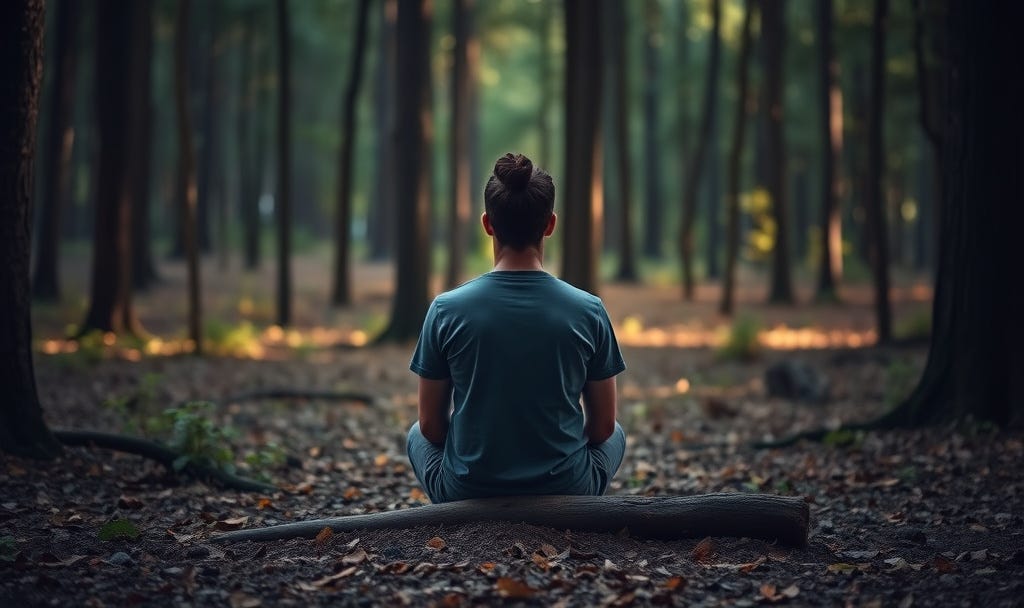
Take a moment to pause. Take a seat, or if needed, come into stillness while standing. Feel your feet/seat in connection to ground. Then, take several slow, full breaths.
- With each breath, invite in a slowing. You can do this by deepening and/or lengthening your breath.
- With each breath, invite in deeper grounding. Breathe all the way down into your root: your feet/seat in connection to that physical surface beneath you.
Other than this gentle focus on your breath, let go of all “doing.”
- Cease all moving and invite your mind to come to rest
- With each thought that arises, refrain from getting caught up in thinking
- On a similar note, with each thought that arises telling you to stop this practice and do something else, simply notice it, then return to the simple practice of breathing consciously (it will happen; simply notice when it does happen, and like all other thoughts, let it rise and fall away)
As you take each breath, your job becomes one of noticing:
- Notice as your breath moves through your body
- Notice as your thoughts move in and out
- Notice as sound, or other stimulus from your environment meets you, perhaps invoking a chain of thoughts.
As you notice, refrain from reacting or getting caught up in any of it. Remember, there is no “doing” now. There is simply being as you breathe deeply, grounding into your body, and noticing what is arising and falling away.
Ready for a second layer of noticing?
With time, notice how you are responding to the practice:
- Are you becoming agitated, the energy of your thoughts building as energy in your body builds?
- Or, are you experiencing deeper peace, an inner stillness developing within?
Understand, this is the main point of today’s practice. It is not to perfect your ability to be in a state of inner stillness; rather, the main point of today’s practice is to cultivate awareness of your response to this simple stillness practice.
More commentary below…
Ready to step onto your own embodied path towards your highest, and most grounded, Self?
The Embodied Path is my brand new approach to cultivating your own embodied spirituality. Consisting of 11 Embodiment Practices taught over the next year, this body of work is here to support YOU on your own sovereign path, as you show up for this world which, let’s be honest, needs A LOT of help right now.
Enter your name and email to get started for FREE today!
How do you respond to stillness? Cultivating awareness as Step 1
As you ask yourself to come into physical stillness, there are different ways that your body/mind/nervous system may respond. For some, we welcome in stillness, letting physical stillness be the simple doorway into inner stillness. Cease all doing, and your mind may, in turn, come to settle in a peaceful stillness. However, for others, physical stillness may actually stir up the mind! It’s as if the cessation of movement (or other forms of “doing”) causes the mind to create wild waves of chaos. The result is altogether unpleasant, and may not serve the practitioner.
Because of this, your first step is one of noticing. What happens when you move into physical stillness? Is this helpful or not when it comes to the goal of creating a state of inner stillness? Become aware of what is happening for you. With this information, we proceed with different approaches.
One more note on this topic. Please know that the response to physical stillness is not always all-or-nothing. Many will experience much of both, especially if this practice is performed over time (for 10, 20, or 30 minutes). For example, when I move into physical stillness, I often experience a wave of wild thoughts, and I allow this wave to build, and then to fall away. With time (perhaps 5 or 10 minutes) my mind may then move into stillness (at least for a short time).
However, other days I invite in physical stillness, and the wave of thoughts actually grows and grows in intensity. Despite calling upon all the fancy tools I have (lengthening my exhale, box breathing, calling in a waterfall of light, etc.), I just don’t have what is needed to force inner stillness.
Fortunately, I know what is needed on these days! My own personal solution? Movement!
Let movement guide you into a state of Inner Stillness
Yes, it’s true. One powerful way to create inner stillness is often through physical movement. Personally, I best find this in yoga or trail running, but the point is, for many of us, the energies in our bodies simply need the physical energy in our bodies to be moved before the mind will begin to settle.
Understand that this is written throughout longstanding traditions. For example, The Yoga Sutras place asana, the physical posture portion of yoga, before they place meditation. They understand that we have to address the physical body before the energies in the mind can be worked with (although, I do not find it true that we always have to do physical movement before meditation / inner stillness practices; again, we are all different, and we arrive to practice in different states each day).
Of course, other longstanding traditions (Qi Gong, for example) focus on moving energy in the body. This is important, and we cannot fall into the “mind over matter” trap that the modern world embraces too enthusiastically
All of this being said, do you have to find a long-standing tradition that teaches you how to move energy in your body before you can begin working on stillness practice? Of course not! One of my own favorite practices is to get into motion (go out and run on the trails, for example). The simple act of moving my body, preferably in nature, is one that readily moves and syncs the energies in my body:
- releasing the more anxious and fiery ones
- invigorating the sleepy/dormant ones
- smoothing it all out such that, when I later move into physical stillness, I have a much better chance of syncing into a peaceful, still state.
For myself, after a movement practice, it may be time to then go sit in meditation. And/Or it may be the case that short pauses while out on the trail is the physical stillness (and mental stillness) that I need for the day (for instance, finding a nice rock, or a great view, or a shady spot beneath a tree becomes the welcome I need to go settle fully into stillness, forget my trail run, and find that peace, joy, and connection with this world that I am seeking).
Know Thyself
The key point, here, is to understand your relationship to the practice of physical stillness. Does asking your body to move into stillness promote peace, or does it promote agitation? Does it do both, and if it does, can you sit with the waves of rising peace and rising agitation?
Also, is movement a useful tool to help guide your mind into inner stillness? Can you find the peace and clarity that you are seeking while in motion?
Can you combine these two in a way that better helps move the agitated energies out of your body so you can then settle into a deeper state of stillness?
One last note before diving into guidance on where to go from here:
Keep in mind, this practice serves as a great baseline for your spiritual practice. It provides powerful information as to your internal state.
For some, it can be a powerful path directly into inner stillness.
For others, it simply offers information regarding the work to be done to guide yourself out of a nervous system state of hyper-mobility – of that need to constantly be doing that our modern, industrialized world knows too well.
Getting something out of this practice? Subscribe to We Are The Forest for further guidance on The Embodied Path.
Beginning next month, our exploration of The Embodied Path will take us into a monthly deep dive into the 11 Spiritual Practices to Build Your Own Sacred Daily Routine.
To get us started, we will begin this March exploring the practice of physical stillness as gateway into inner stillness.
Please understand that these two are not the same:
- Physical stillness being a practice, one that is done with your physical body
- Inner stillness is an experience, and it is one that cannot be forced, yet is spontaneously experienced when the conditions are right
Each of the 11 Spiritual Practices will offer opportunities to cultivate inner stillness, along with all those other spiritual qualities that we are here for (peace, bliss, clarity, connection, insight, love, compassion, etc.)
With time, we will explore all 11 Spiritual Practices, including many variations of each and opportunity to make each practice your own.
But again, we begin with the first step: a practice of physical stillness. Whether this is a practice that you come to embrace wholeheartedly as a guide into your inner stillness, or whether this becomes a powerful piece of information that guides you to the next practice that can help support you… well, you’ve got to go find out!
Enter your name and email to get started today!
#embodiment #embodiedliving #spiritualembodiment #spiritualpath #spiritualawakening #newearthembodiment #newearth #innerstillness #meditation