A note to the reader: “Centering” is a practice and a skill that is taught as the second step along The Embodied Path. This post serves as our official post on centering. You can learn more about The Embodied Path and all related practices across this website.
To receive all posts, podcasts, and offerings surrounding The Embodied Path, make sure you are subscribed to The Mountain Mystic Newsletter.
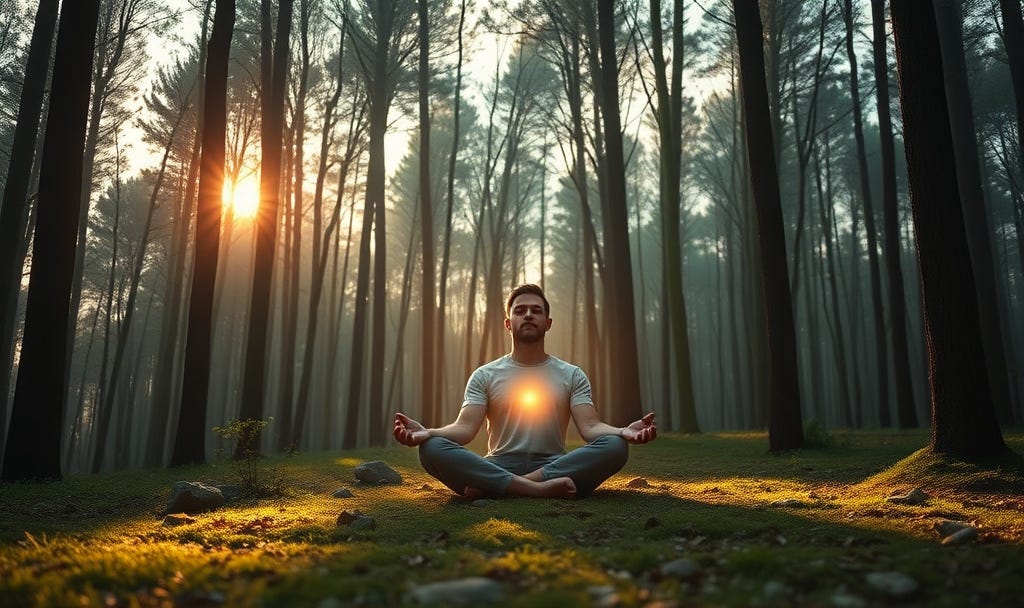
Center is a point, but it is not a fixed point. It is a tool that helps collapse the complexities and dynamic nature of your being into one simple location, while also being that which holds the infinite potential of who you are in its form.
Center is here to hold you within a world that is wild and ever-changing, dynamic as it is both adventurous and often even scary.
Center means knowing yourself as whole and eternal even as parts of you may shift and change.
Centering as part of The Embodied Path
I began this series because I wanted to create a framework that provides meaning for:
- Navigating this wild world while being as skillful as possible
- Being present in reality, experiencing what is – especially that which is beautiful, joyful, fulfilling, and meaningful, as well as that which is difficult, challenging or even painful
The short of it? How can we be present in all of it – in all of life! – as we call upon wisdom and discernment to move through it all with as much skill as possible?
In answer to this questioning, what emerged is what I now call “The Embodied Path” – a simple yet wholly dynamic framework that meets the individual exactly where they are, never forcing anyone to fit a mold that they do not fit, while always holding space for that truer, more skillful version of self.
The Embodied Path emerges as a 4-step process. It is one that is far from linear and never promises any idealized state when followed in perfection. Rather, it is a set of skills & states to be practiced, repeated over time as the whole process is iterated. With time, practice of skills begins to emerge spontaneously.
The process is, simply, the following:
- Grounding
- Centering
- Alignment
- Discernment
You can read more about The Embodied Path in this post. As for our breakdown of each part of the process…
At this point in our series, I have written in depth about grounding, and in a recent post wrote what is to date my most comprehensive post on the subject.
Today our task is to do the same with the second theme: centering.
What is “Centering” and why is it important?
Centering – the process of coming into the core of your being, becoming conscious of Self as you are in connection to the world that expands far beyond self.
In this definition, the use of the capital “S” in Self signifies that we are not talking about some limited, egoic version of self. Rather, this is the whole being that you are:
- mind and body
- heart and soul
- spirit
- etc.
When we talk about embodiment, we are talking about this whole being that you are: A complex being, one that exists with aspects that are probably even unknown to you. You can “do the work” that it takes to bring awareness to all these parts of Self, and you can “do the work” that it takes to heal, befriend, or otherwise come into skillful connection with all these parts of Self. This can be important work.
AND.
And, you do not have to be conscious of all aspects of Self and everything that is happening all at once to be centered. Again, centering is about collapsing the complexities of life down into a single point. Find center, and you allow stillness to settle in place of chaos.
To connect this “Self” portion of the definition to the second half of what is stated above, you have to understand that centering, as with all aspects of The Embodied Path, is not a selfish act. Rather, it is about coming into connection with Self as part of a far greater whole. When we center, we do it in a way that is not disengaging from the world beyond Self, but instead, actually results in a deeper knowing of our interrelated nature.
In a moment, I will offer a practice to help you dive straight into what I mean, allowing you to experience for yourself what this can offer you. Before this, I wish to add one more piece to contextualize the work offered here within the broader body of work that is The Embodied Path.
(A quick aside) Practices that support your cultivation of The Embodied Path
As I teach The Embodied Path, I find it useful to divide the work into the following:
- Skills and States that we are working to cultivate, as is discussed here in this post
- Foundational practices that help us to cultivate these skills and states, as is being discussed in parallel in other blog posts
While one half of The Embodied Path offers a spiritual exploration of Self in relation to Life through the above 4-step process (again, one focused on skills and states), the other half of The Embodied Path offers a practice-centered approach to embodiment.
Currently we are approaching Practice #4 of 11 total embodiment practices that are worth exploring for the modern practitioner.
In Practice #3 we spoke to focused consciousness, that which looks a lot like channeling one’s attention to a single task/point. I write today’s piece on centering between practices #3 and #4.
With Practice #3 we focus consciousness.
With Practice #4 we expand consciousness.
I write today’s piece on centering between the two — not as a numbered practice itself, but as the hinge connecting them. Consider what follows a threshold piece: centering is what supports you as you move from focused attention to expanded awareness.
Make sense? Let’s give it a try.
Centering Practice
Read through the practice in its entirety before you begin. When you are ready, go through the simple steps in the order they are written out. Feel free to come back to the writing for guidance along the way. Alternatively, you may put away the screen and sink into the practice, doing your best to follow the steps while trusting that whatever form you follow is what is best for you today.
Practice
Come into a comfortable seated position. Begin by taking a few moments to settle, focusing on some full, ease-filled breaths.
Feel your breath in your body:
- inhale, sensing into how your rib cage, and maybe even your abdomen expands
- exhale, doing so with an invitation to let go of any thoughts or energies that you brought into this practice that do not serve
- repeat for 5-10 breaths
When you are ready, go to your “center.” Understand that where exactly this is in your body does not matter so much. Maybe “center’“ is in your heart. Maybe it is in your solar plexus. Maybe it is around or just below your navel. Again, it does not matter where you go. Today, ask yourself where your center is, then tune into this space.
Come into your center, wherever you feel or otherwise perceive it today. Bring your full attention here.
Spend some time at center. I recommend about 8-10 breaths. Use your breath to help you focus your attention. If your attention veers (which it probably will), simply bring it back to center.
Once you feel confidently “centered” your task is going to shift. Now, as some part of you remains at center, your task is to begin to expand. That is, with some aspect of your focused attention at center, your awareness is going to simultaneously expand outward:
- Begin by expanding your awareness to your body. That is, become present to the whole of your body
- Then, begin to expand your consciousness beyond your skin. Feel into the immediate environment surrounding you
- After this, expand into the room you are in…
- The whole building you are in…
- The whole community/ecosystem you are currently in…
- Expand across your whole nation…
- The whole world…
- Perhaps, even, the Universe
Throughout this expansion practice, take moments to remember yourself at your center. Your breath can help you do this.
When you are ready to close down the practice, come back fully to center. Breathe into your whole body as you feel your feet on the floor / your seat in your chair. Tune into the center of your being once again as you know yourself as centered in your body in the room in which you currently reside.
Coming home to your practice
The practice of centering has to do with being at home in oneself, setting the stage for being at peace and having clarity even among the chaos of life unfolding as it does.
Of course, as we know, this idea is not always easy to actually put into practice in a way that manifests as perfect peace and clarity. As with all aspects of The Embodied Path, practice is what is key. More than this, it is about finding practices that work for you given where you are. No practice is perfect. No practice is a one-size-fits-all.
It is my hope that the practice above is able to offer you support in your centering. If you found this to be so, I recommend committing to a daily practice (else, practicing at least several times a week) so that the practice becomes ingrained within you, and center becomes a more stable state (and not one that you have to constantly reach for).
One more note before closing down for today. It is important to put into context that we are, indeed, living in wildly chaotic times. For many, the stability that had been experienced is crumbling away. For others, like my millennial self, I never got to set solid foundations before the world went to hell. In other words, I have never really known center nor stable foundations. Because of this, I find it extra difficult to even know what it means to be grounded and centered in this world.
Fortunately, The Embodied Path is a set of principles and practices that are not necessarily tied directly to external aspects of life. Does it helps to have a stable environment to center into? Of course it does! Still, with time we find that we are able to center and ground even as the world around us shifts and changes (and, in a lot of ways, falls away).
Finding center is not about finding a fixed point. This is not an aspect of you that is physically tied to all that is unfolding. Center is a spiritual point. It exists in perpetuity. It is always there for you to reach towards, and hopefully, to find in times of need.
And, with time and practice, we find that center is a state which arises spontaneously. This is a good thing. We want to be centered because we want to be at home in our spiritual nature, grounded within Self as we do all we can to navigate this wild world as skillfully as is possible.